
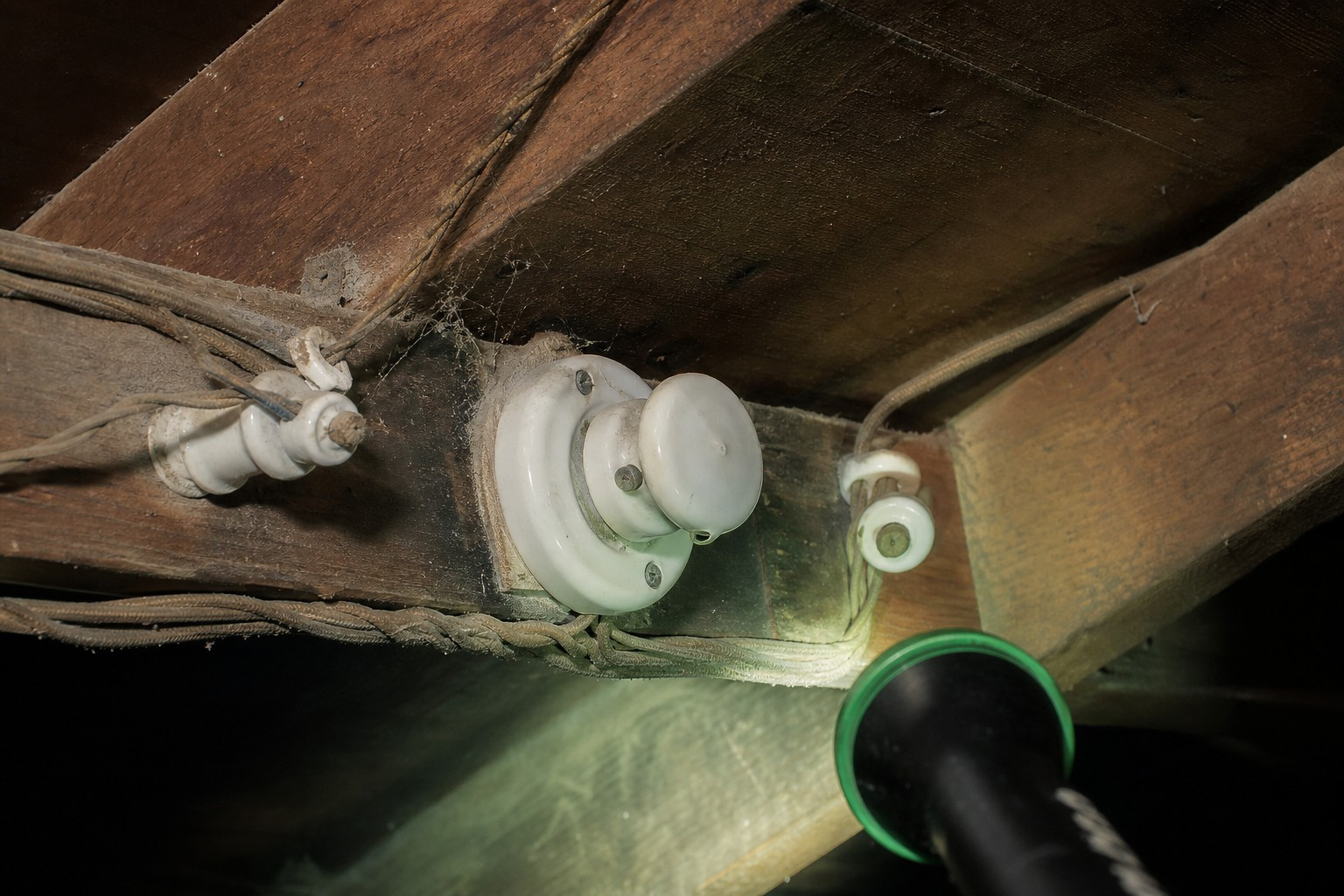
What Is Knob-and-Tube Wiring and Is Your Older Houston Home at Risk?
Knob and tube wiring is the original electrical wiring used in homes from about 1880 to the 1940s. It has no ground wire. Its insulation gets brittle with age. It was never built for today's air conditioners and modern appliances. If your Houston home was built before 1950, it may still have some. Aaron-Carter Electric has replaced old electrical wiring with modern wiring in Houston area homes since 1998.
⚡ Quick Summary
Knob and tube wiring was standard from about 1880 to the 1940s (InterNACHI). It has no ground wire.
About 79,000 homes in the City of Houston were built before 1950 (City of Houston Planning, 2024). Many in the Heights, Montrose, Eastwood, and Riverside Terrace still have some of it.
Many insurers refuse to cover homes with knob and tube unless a licensed electrician has evaluated it (InterNACHI).
Full replacement costs $12,000 to $36,600, or about $10 to $20 per square foot (Angi, 2026).
Never bury it under attic insulation. Never add outlets to it. Have a licensed pro inspect it first and tell you if the wiring should be replaced.
Houston is a young city with some very old houses. Walk the Heights, Woodland Heights, Montrose, or the Old Sixth Ward and you will see bungalows and Victorians built when electricity was new. Many have been updated. Some have not. This guide explains what knob and tube wiring is and how to tell if your home has it. It also covers the real risks, how it compares to modern wiring, and what it costs to replace knob and tube wiring in Houston.
What Is Knob and Tube Wiring?
Knob and tube wiring (sometimes written K and T wiring) is a two-wire system. It dates to the 1880s, the era of Thomas Edison's first power stations. It was the standard way to wire a house until the 1940s.
Hot Wire, Neutral Wire, and No Ground Wire
One hot wire and one neutral wire run separately through the house. Ceramic knobs hold the conductors away from the wood framing. Ceramic tubes protect the wiring where it passes through joists and studs. The copper conductors are covered in rubber insulation with a cloth wrap. There is no ground wire at all.
It was a good system for its time. Homes in 1920 had a few lights and maybe a radio. The wiring had open air around it to dissipate heat. But the system has three built-in limits:
No ground wire.
Modern outlets have three prongs for a reason. The third prong is the ground. It protects you and your electronics. Knob and tube has none.
Aging rubber insulation.
Rubber and cloth get brittle after 80 to 100 years. Bare copper conductors behind a wall are a fire waiting for a spark.
Low capacity.
It was sized for lighting, not for the electrical loads of central air, a dryer, a microwave, and a hair dryer running at once. Modern appliances pull far more power than the wiring was designed for.
The International Association of Certified Home Inspectors calls the system obsolete. It says inspectors should always flag it in a report.
Knob and Tube Wiring vs Modern Electrical Systems: What Is the Difference?
Modern electrical systems fix every weak point in knob and tube wiring. Here is how the old wiring compares to the modern wiring installed in homes today:
Ground wire.
Modern wiring has a third conductor, the ground wire. Knob and tube has none. The ground gives a fault a safe path and lets GFCI and surge devices work.
Cable type.
Modern systems use NM cable, often called Romex. The hot, neutral, and ground run together inside one plastic jacket. Knob and tube runs each wire alone across ceilings and through walls.
Junction boxes.
Every splice in a modern system sits inside a junction box. Knob and tube splices were soldered and taped in open air.
Circuit protection.
Modern panels use circuit breakers. Knob and tube homes usually had a fuse box. Fuses work, but many were upgraded to oversized fuses over the years, which lets the wiring overheat.
Insulation.
Modern wiring uses heat-rated plastic insulation that can sit in contact with attic insulation. Knob and tube uses rubber insulation that must stay in open air.
Capacity.
Modern electrical systems run 100 to 200 amps with 15 to 20 circuits or more. Knob and tube homes often had 30 to 60 amps and a handful of circuits.
The short version: modern wiring is grounded, boxed, protected by circuit breakers, and built for today's electrical demands. Knob and tube wiring is none of those things. That is why older homes with it should be upgraded.
How Do You Know If Your Houston Home Has Knob and Tube?
Start with the age of the house. Then look in the attic and the basement or crawl space. Here are the signs:
Built before 1950.
Houston's own housing data shows 41,296 homes built in 1939 or earlier. Another 37,958 were built from 1940 to 1949. That is about 79,000 homes inside the city (City of Houston Planning, 2024). Council Districts H and I, which cover the Heights, Near Northside, and the East End, have the largest share.
White ceramic knobs
nailed to rafters or joists with single wires looped around them.
Ceramic tubes
where a wire passes through a board.
Two-prong outlets
throughout the house with no ground. This is common in older homes that still have knob and tube wiring.
Cloth-covered wire
at the panel or in a junction box.
No junction boxes.
Splices in knob and tube were soldered and taped in the open air, not inside a box.
Many older homes in Houston are a mix. A 1930s bungalow may have new wiring in the kitchen from a 1990s remodel and original knob and tube in the bedrooms and attic. That mix is common, and it is where problems hide.
“Do not touch it to check it. Old insulation crumbles in your hand and the wire may be live. Take a photo from a safe distance and send it to an electrician.”
Is Knob and Tube Wiring a Fire Hazard?
Knob and tube wiring is a fire hazard when it has been modified, overloaded, or covered in insulation. Original, untouched, lightly loaded knob and tube wiring can still work. The problem is that almost no 90-year-old system is untouched.
Here is what makes it risky in a Houston home:
Attic insulation.
Houston homes get blown-in insulation above the ceilings to fight the heat. Knob and tube wiring needs open air to dissipate heat. When you insulate over it, the buried wiring overheats. InterNACHI advises that any insulation around knob and tube be carefully removed.
Bad splices.
Decades of do-it-yourselfers and handymen have tapped new electrical outlets and switches onto the old wiring with tape and hope, with no junction box.
Modern loads.
Window air conditioners, space heaters, and kitchen appliances pull far more power than the wiring was built for. Overheating follows.
No ground.
A fault has nowhere safe to go. That is a shock risk and a fire risk.
Wiring and related equipment cause about 68 percent of home electrical fires. Fires that start in hidden spaces like ceilings and walls can burn for a long time before anyone notices (NFPA).
Not sure where to start? Talk to a licensed Houston electrician. | Call (713) 962-2797 |
Will Insurance Cover a Home with Knob and Tube Wiring?
Often not. Many insurance companies refuse to write a policy on a home with knob and tube wiring because of the fire risk. Safety is the reason. Some make an exception when a licensed electrical contractor has inspected the system and confirmed it is safe. Others require that the knob and tube wiring be replaced before coverage starts. Source: InterNACHI.
This matters most when you buy or sell. A buyer's lender needs insurance to close. If the insurer says no, the deal stalls. Buyers often use a rewiring estimate to negotiate the price down. Sellers who replace the wiring first avoid that fight and can market the home as fully upgraded.
How Much Does It Cost to Replace Knob and Tube Wiring?
Replacing knob and tube wiring costs $12,000 to $36,600 for a whole house, or about $10 to $20 per square foot (Angi, 2026). Here is how that breaks down by home size:
1,000 sq ft
$10,000 to $20,000
1,300 sq ft
$13,000 to $26,000
1,600 sq ft
$16,000 to $32,000
2,000 sq ft
$20,000 to $40,000
What moves the price: how easy the attic and crawl space are to reach, how many walls and ceilings have to be opened, how many outlets, switches, and light fixtures you add, and whether the panel needs to be replaced at the same time. Most older homes in Houston also need a panel upgrade to 200 amps with modern circuit breakers, since the original service was often 60 amps.
A whole-home rewire is a permitted job in the City of Houston. It gets a rough-in inspection and a final inspection. We pull the permit and meet the inspector. Once the old wiring is replaced, the home is on a modern electrical system that can be insulated, upgraded, and added to safely for decades. See our residential electrical page for how a rewire works.
“Do it in stages if you need to. Many homeowners replace the kitchen, bath, and attic wiring first, since those circuits carry the biggest loads and the most heat. The bedrooms and living areas follow later. A good plan leaves nothing unsafe on the old wiring.”
Can Do-It-Yourselfers Replace Knob and Tube Wiring, or Do You Need a Licensed Electrician?
You need a licensed pro. In the City of Houston, a rewire needs a permit, and the city only issues electrical permits to registered master electricians. Beyond the rules, there are practical reasons:
Live wiring.
Old knob and tube circuits are often still active, even when they look abandoned. It takes testing to know which conductors carry power.
Plaster walls.
Houston bungalows have plaster and lath. Fishing modern wiring through them without tearing up the house takes experience.
Load planning.
A rewire is the moment to plan circuits for the kitchen, the air conditioner, and future needs like an EV charger. Get it right once.
Inspection.
The city inspector checks every junction box, every circuit, and the panel. Work that fails has to be redone.
A licensed contractor also carries insurance. If something goes wrong in your walls, you are covered.
What Should You Do Next?
If you think your home has knob and tube wiring, take these three steps:
Get it inspected
by a licensed electrical contractor. Not a handyman. Not a guess from the hatch.
Stop adding load.
No new outlets, no space heaters, no blown-in insulation over the wiring until you know what you have.
Get a written replacement plan and price.
Use it to budget, to negotiate a purchase, or to satisfy your insurer.
Why Houston Homeowners Trust Aaron-Carter Electric
Aaron-Carter Electric has served Houston, Spring, The Woodlands, Humble, Conroe, Cypress, Katy, Sugar Land, Pearland, Tomball, Magnolia, Montgomery, Willis, Kingwood, and Atascocita since 1998. We are a licensed and insured Texas electrical contractor. We have worked in Houston's oldest neighborhoods for more than 25 years. We know how to replace the wiring in a plaster-and-lath house without tearing it apart. Every job is done to one standard: Fixed Right. The First Time.
Browse our full list of electrical services for rewiring, panels, and inspections.
“Aaron-Carter Electric is a licensed, insured Houston electrical contractor serving the Greater Houston area since 1998. The team inspects and replaces knob and tube, aluminum, and other outdated wiring in older Houston homes. It handles the City of Houston permit and inspections on every rewire.”
About the Author
Aaron McAlexander leads Aaron-Carter Electric, Inc., a family-owned electrical contractor that has served Houston and the surrounding communities since 1998. The team handles residential and commercial work, panel changeouts, generators, lighting retrofits, and thermography inspections. Fixed Right. The First Time.
Ready to Get It Fixed Right?
Licensed, insured, and serving Houston since 1998. Free estimates, permits pulled, city inspections passed. Fixed Right. The First Time.
| 📞 Call (713) 962-2797 | Get a Free Estimate |
Houston • Spring • The Woodlands • Humble • Conroe • Cypress • Katy • Sugar Land • Pearland
