
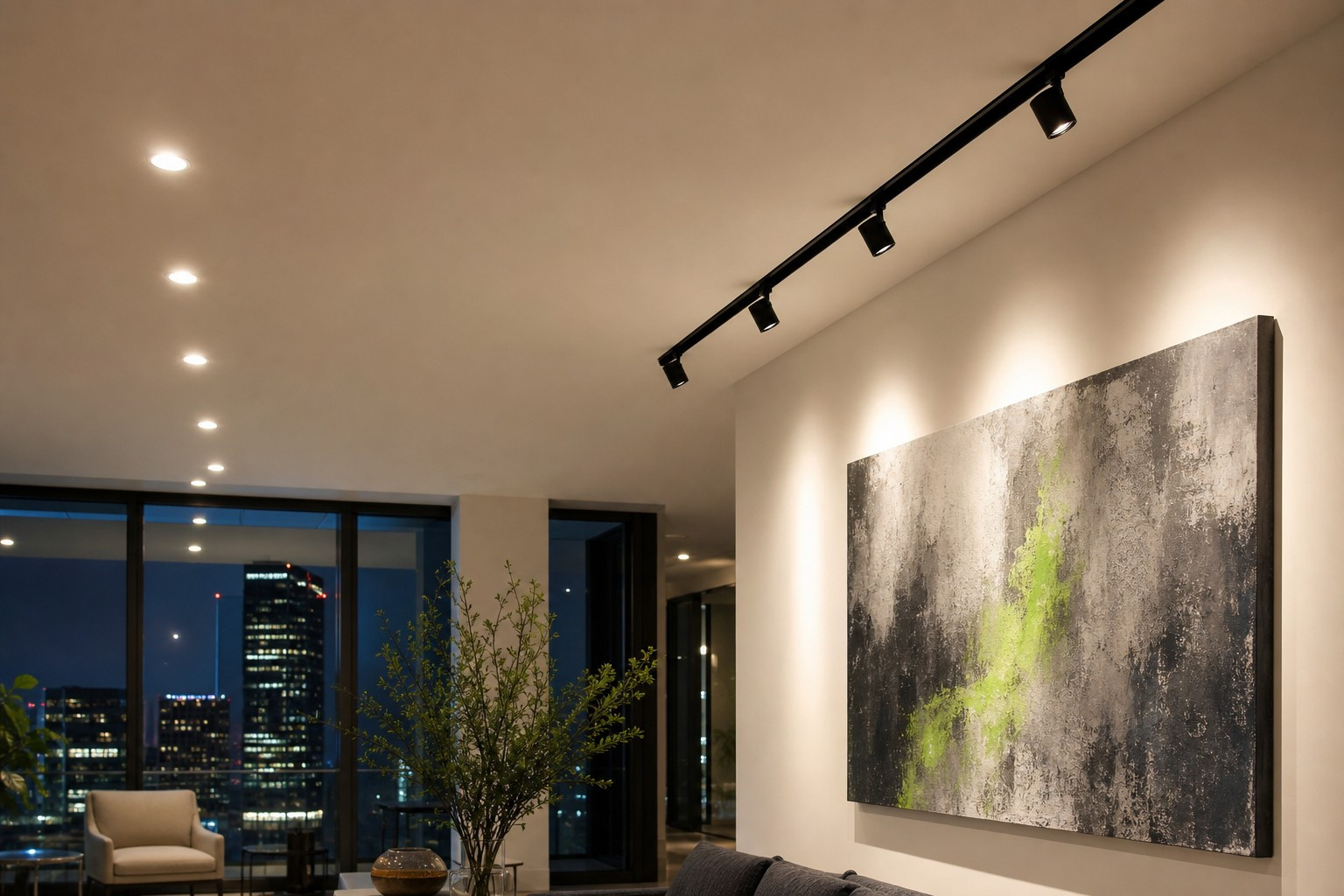
Recessed Lighting vs Track Lighting: Which Is Right for Your Space
Recessed lighting is the better choice for clean, even light across a whole room. Track lighting is the better choice when you want to aim light at art, a counter, or a work area, or when you cannot cut into the ceiling. Both cost about $100 to $300 per fixture installed. Aaron-Carter Electric has installed both lighting types in Houston homes and businesses since 1998.
⚡ Quick Summary
Recessed lighting sits inside the ceiling. It gives smooth, even light and a clean look. Best for living rooms, kitchens, and low ceilings.
Track lighting mounts on the ceiling. Each light head can be aimed. Best for artwork, task lighting, and rooms where you cannot open the ceiling.
Recessed lights run $100 to $300 per fixture installed, about $180 on average (HomeAdvisor, 2025). Track lighting runs $100 to $300 when it uses an existing fixture box (Angi).
Both should use LED bulbs. LEDs use about 75 to 80 percent less energy than old bulbs (U.S. Department of Energy).
In the City of Houston, installing or moving a light fixture needs an electrical permit pulled by a licensed contractor.
Houston homes come in every style. A 1960s ranch in Spring Branch. A two-story in Katy with 10-foot ceilings. A loft near downtown with exposed beams. The right lighting depends on the room, the ceiling height, and what you do in the space. This guide compares recessed lighting vs track lighting so you can pick the right type of lighting before the install crew shows up.
What Is the Difference Between Recessed Lighting and Track Lighting?
Recessed lights are set up inside the ceiling. You see a small trim ring and the light itself. These can lights are the most common lights in new Houston homes. Nothing hangs down. Track lighting is a linear track mounted on the ceiling surface. Light heads clip onto the rail. You can slide them along the track and aim them where you want.
That one difference drives almost every other choice: how the room looks, how much you can adjust later, how hard the installation is, and what it costs. Recessed lighting works as general ambient lighting that blends into the design of the room. Track lighting offers directional lighting that you can easily adjust, which gives you more flexibility down the road.
“Simple test: If you want the light to disappear, choose recessed. If you want to point the light at something, choose track.”
Lighting Types Explained: Recessed Cans, Track Systems, and Pendants
Most rooms use one of three lighting types on the ceiling. Each one has distinct advantages.
Recessed cans.
Also called pot lights or downlights. A can or a thin canless LED fixture sits in a hole in the ceiling. Modern recessed lights are slim, energy efficient, and come in trims that blend into the ceiling for a minimalist aesthetic.
Track lighting systems.
A track carries power along its length. Light heads plug in anywhere along the track. You can add, remove, or reposition heads later without new wiring. This is the flexible option.
Pendants and chandeliers.
These hang down from one point. Pendants over a kitchen island or a dining table give a focal point. They are decorative lighting more than general lighting.
Wall sconces and lamps round out the room. But the big decision for most Houston homes is between recessed cans and track lighting, so the rest of this guide focuses on those two.
When Is Recessed Lighting the Right Choice?
Recessed lighting is right when you want even general illumination and a clean ceiling. Here is where recessed lighting shines.
Living Room and Bedrooms
Even light with no glare makes a living room feel calm and open. Four to six recessed cans on a dimmer cover a normal living room and let you set the atmosphere for movie night or company. Bedrooms need fewer fixtures, often two to four, plus lamps by the bed for soft light at night.
Kitchens
A grid of recessed cans lights the whole floor. Add under-cabinet strips for the countertop. Many Houston kitchens then add two or three pendants over the kitchen island as an accent.
Low Ceilings and Ceiling Height
Nothing hangs down, so 8-foot ceilings feel taller. Recessed lighting is the best bet for low ceilings and hallways. Fewer fixtures are needed than you might think: one light for every 4 to 6 feet of space is a common starting point. In rooms with high ceilings, recessed cans still work, but you need brighter LEDs or more of them to light the floor.
Bathrooms and Closets
Wet-rated recessed lights work over showers where track heads cannot go. Small closets and nooks do well with one recessed light each.
The trade-off is the installation. Each of the lights needs a hole and a run of wire in the attic or the space above. In a two-story home, the first floor ceiling has no attic access, so the crew works through the holes. Joists, ducts, and old wire can add cost. HomeAdvisor notes that obstacles can add $200 or more per light in an existing home. Patching and paint may be needed if a hole is cut in the wrong spot, so placement matters.
When Should You Choose Track Lighting?
Choose track lighting when you need to aim light or when the ceiling cannot be opened. Track lighting is the more flexible option, and it fits these spaces best.
Task Lighting and Accent Lighting
Track lighting is built for task lighting. Point a light head at the desk, the workbench, or the reading chair. It is also ideal for accent lighting and highlighting artwork. Aim each head at a painting, a shelf, or architectural features like a brick wall or exposed beams. Art galleries and showrooms use track for this reason.
Concrete or Beam Ceilings
Many Houston lofts and garages have no space above the ceiling. Track mounts on the surface of existing ceilings. One electrical connection at the fixture box powers the whole track.
Rentals and Quick Updates
Track can use the existing fixture box, so one box can power six heads. There is no cutting and no patching, which makes the setup easier and cheaper. If you move, the track comes down and the old fixture goes back up.
Retail Stores, Offices, and Studios
One of our commercial customers, a dance studio, had us exchange five of their studio lights. In her review, Sandy M. said "the entire process was smooth from start to finish." Track lighting systems let a business change the layout for seasonal displays or new collections without new wire runs.
The trade-off is the look. Track is visible. Some people love the modern, industrial feel. Others want a bare ceiling and a seamless look. Track heads also collect dust and need a wipe now and then, so maintenance is a bit higher.
Not sure where to start? Talk to a licensed Houston electrician. | Call (713) 962-2797 |
Pros and Cons of Recessed Lights vs Track Lights
Here is a side-by-side look at the pros and cons of each type of lighting. Use it when you are choosing between the two for a specific room.
Recessed Lights: Pros and Cons
- Pros. Clean design. Even light that fills the space. Works with any decor style. Makes rooms feel taller. Wet-rated cans work in showers. Canless LED lights are slim and very energy efficient.
- Cons. Fixed position. Once the cans are in, the lights stay where they are. Installation is harder in finished ceilings and needs more labor. Too many cans can create a "runway" look, so spacing and design matter.
Track Lights: Pros and Cons
- Pros. Flexibility. Slide, aim, add, or remove light heads at any time. Perfect for artwork, shelves, and task areas. Simpler installation on existing ceilings. Sleek modern styles in black, white, or brushed metal.
- Cons. The track and the lights are visible. Light heads collect dust. Direct light from track heads can create glare if aimed at a TV or a glossy countertop. Not ideal as the only lighting in a large space.
Neither option is wrong. The best design often combines both: recessed lights for general illumination and track lights to focus on the areas that matter.
How Much Do Recessed Lighting and Track Lighting Cost?
Both options land in the same price range per fixture. The total depends on how many fixtures you need, the labor to reach the wiring, and how much new wiring is involved.
Recessed lighting costs
$100 to $300 per fixture installed, with an average near $180. Canless LED units run about $200 to $300 each installed. Source: HomeAdvisor, 2025.
Track lighting installation
$100 to $300 when the room already has an overhead fixture box. New wiring and a junction box add $100 to $200. Source: Angi.
Permit
In the City of Houston, installing or moving a light fixture requires an electrical permit. Permit fees typically run $10 to $500 by project (HomeAdvisor, 2025). We include the permit in your estimate.
Where the two split is scale. A kitchen with six recessed lights is six ceiling holes, six can lights, and six sets of wire. A single track with six light heads is one mounting job. So for a large room with no existing wire runs, track lights can be cheaper up front. For a whole-home plan, recessed usually gives the best result per dollar. Several factors change the number, so get a quote for your space instead of guessing.
Energy Efficiency: Which Light Fixtures Cost Less to Run?
Both light fixtures are energy efficient when you use LED technology. The fixture style does not change your energy costs much. The bulb type does. LED bulbs use about 75 to 80 percent less energy than traditional incandescent bulbs and can last 3 to 25 times longer, according to the U.S. Department of Energy. In Houston, LEDs also put out less heat, which means less work for your air conditioner in August. That is how the right lighting can save money every month.
Two more energy efficiency tips from our install crews:
- Pick a color temperature and stick to it. 2700K to 3000K feels warm. 3500K to 4000K feels bright and clean. Mixing them in one room looks off.
- Put every zone on a dimmer. Make sure the dimmer is rated for LEDs. A cheap dimmer causes flicker and buzz. Dimmers also cut energy use when full brightness is not needed.
We handle full LED lighting retrofits for homes and businesses if you want to make every fixture highly energy efficient at once.
“Many rooms do best with both. Recessed lights give the base layer of ambient light. A short track over the art wall or a few pendants over the kitchen island add the accent. Layered lighting solutions are what make a room feel finished.”
Recessed Lighting vs Track Lighting: Which Should You Pick?
Use this quick guide to make an informed decision:
Want a clean ceiling and even light? Recessed.
Want to highlight specific areas like art or a work area? Track.
Ceiling is concrete or has no attic access? Track.
Low ceilings under 8 feet? Recessed.
Wet area like a shower? Recessed (wet-rated).
Want to change the layout later? Track.
Want a focal point over a table or island? Pendants, with recessed cans around them.
Want the most flexibility as your furniture and art change? Track.
Still stuck? Think about how you use the room. General lighting for daily life points to recessed. Task lighting and accents point to track. Many Houston homes end up with both track and recessed lights in the same open floor plan, and that mix often looks the best. Making the choice room by room is easier than picking one style for the whole house.
Why Houston Homeowners Trust Aaron-Carter Electric for Lighting Solutions
Aaron-Carter Electric has served Houston, Spring, The Woodlands, Humble, Conroe, Cypress, Katy, Sugar Land, Pearland, Tomball, Magnolia, Montgomery, Willis, Kingwood, and Atascocita since 1998. We are a licensed and insured Texas electrical contractor. We install recessed lighting, track lighting, and pendants in homes and commercial spaces, pull the permit, and make sure every fixture is on a circuit that can handle it. Professional installation means no flicker, no loose trim, and no surprise ceiling holes. Our promise is simple: Fixed Right. The First Time.
See our full list of electrical services for lighting, panels, and more.
“Aaron-Carter Electric is a licensed, insured Houston electrical contractor serving the Greater Houston area since 1998. The team installs recessed, track, and LED lighting for homes and businesses and handles the City of Houston fixture permit on every project that needs one.”
About the Author
Aaron McAlexander leads Aaron-Carter Electric, Inc., a family-owned electrical contractor that has served Houston and the surrounding communities since 1998. The team handles residential and commercial work, panel changeouts, generators, lighting retrofits, and thermography inspections. Fixed Right. The First Time.
Ready to Cut Your Lighting Bill?
Licensed, insured, and serving Houston since 1998. Free estimates, permits pulled, city inspections passed. Fixed Right. The First Time.
| 📞 Call (713) 962-2797 | Get a Free Estimate |
Houston • Spring • The Woodlands • Humble • Conroe • Cypress • Katy • Sugar Land • Pearland
